 Roser Bernabé
Turning an industry's sustainability reports into answers
Large European companies must now publish an audited sustainability report. The hardest part is deciding what goes in it. We built an AI benchmark that shows what the whole industry reports, so teams can do it in minutes instead of weeks.
Why now
Datamaran helps nearly 500 large companies, like Visa, Amazon, Dell, Cisco and PepsiCo, manage sustainability risks and reporting. Three things made this the right moment:
- A new law: The EU's CSRD makes thousands of companies publish an audited sustainability report every year.
- New data: The first CSRD reports are out, so we can finally see what each industry reports.
- AI: Language models can read and classify those long reports at scale.
What an IRO is
Before writing their report, companies list how they affect the world, and how the world could affect them. Each item is an IRO: an Impact, a Risk or an Opportunity. For a chocolate maker:
| Type | Example |
|---|---|
| Positive impact | Our training program raises cocoa farmers' income |
| Negative impact | Our plastic wrappers add to packaging waste |
| Risk | A plastic tax could raise our costs |
| Opportunity | Plastic-free packaging could win new customers |
The problem
Talking to clients across logistics, payments, tech and consumer goods, one question came up more than any other:
“Is my analysis complete, and what am I missing?”
- Benchmarking by hand: Analysts read competitors' reports one by one and copied every IRO into spreadsheets.
- No answer for the board: Leadership asked “are we in line with our sector?” and nobody had evidence.
- Fear at audit time: A missing IRO found late by the auditor means rework and a delayed report.
The vision
Give every sustainability team the knowledge of an analyst who has read every report in their industry.
The solution
The IRO Landscape is an AI benchmark built into Datamaran's materiality assessment, with three pillars: a map of the industry, an AI assistant and a co-creation assistant.
The foundation: AI that reads the market
All three pillars stand on Datamaran's AI, which reads more public text than any team could:
| Source | What the AI reads | Why it matters |
|---|---|---|
| Corporate reports | Annual, sustainability and CSRD reports from about 10,000 companies | What competitors say about themselves |
| Regulations | Over 19,800 laws and initiatives in more than 190 countries | What companies must do now, or soon |
| News | Global online media | What the public and investors talk about |
| Social media | Public posts and conversations | How people react to issues and companies |
For the IRO Landscape, the key source is audited CSRD reports. The AI finds every IRO, classifies it by topic, type and value chain, and picks up new reports as they come out.
1. Landscape Map
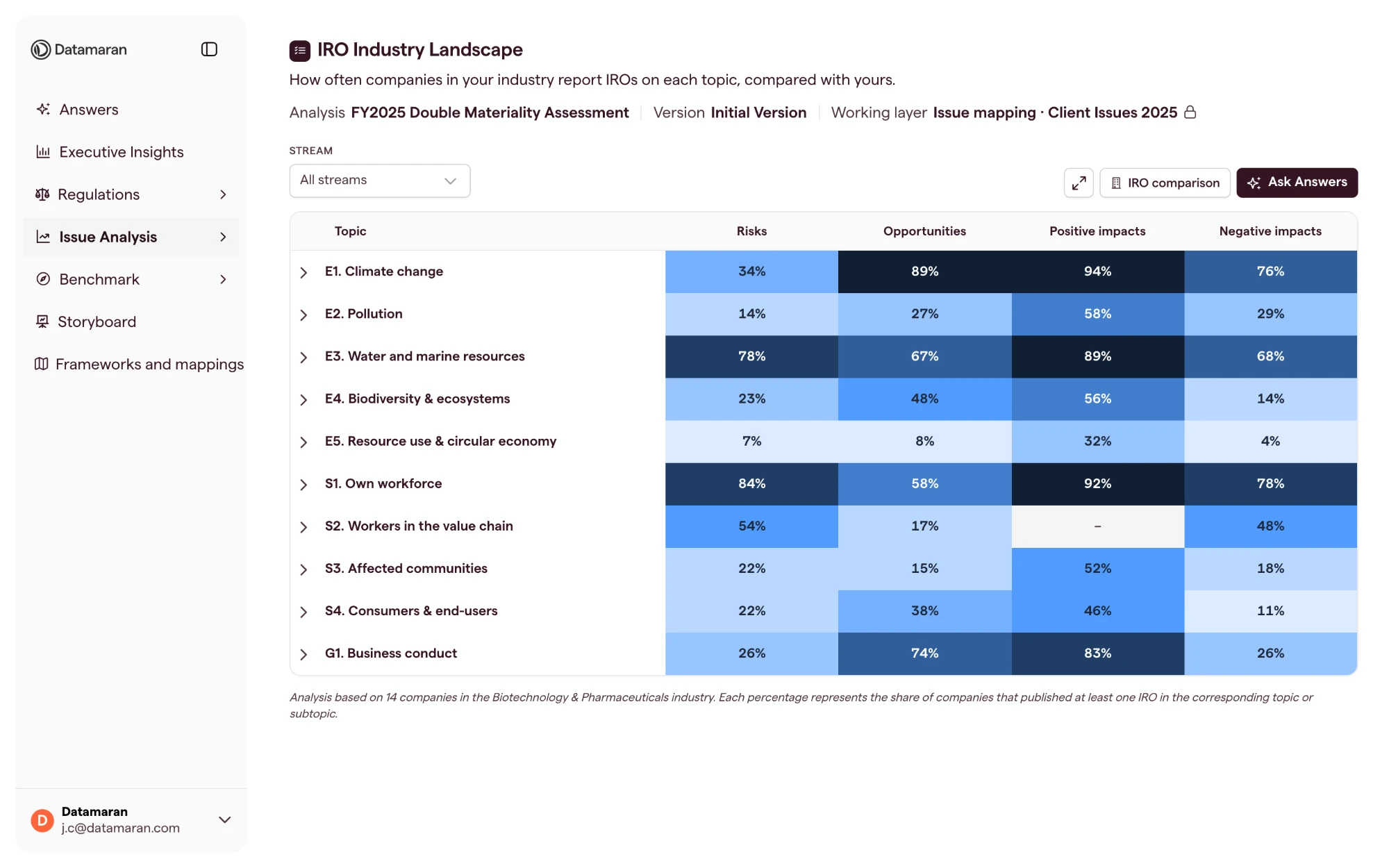
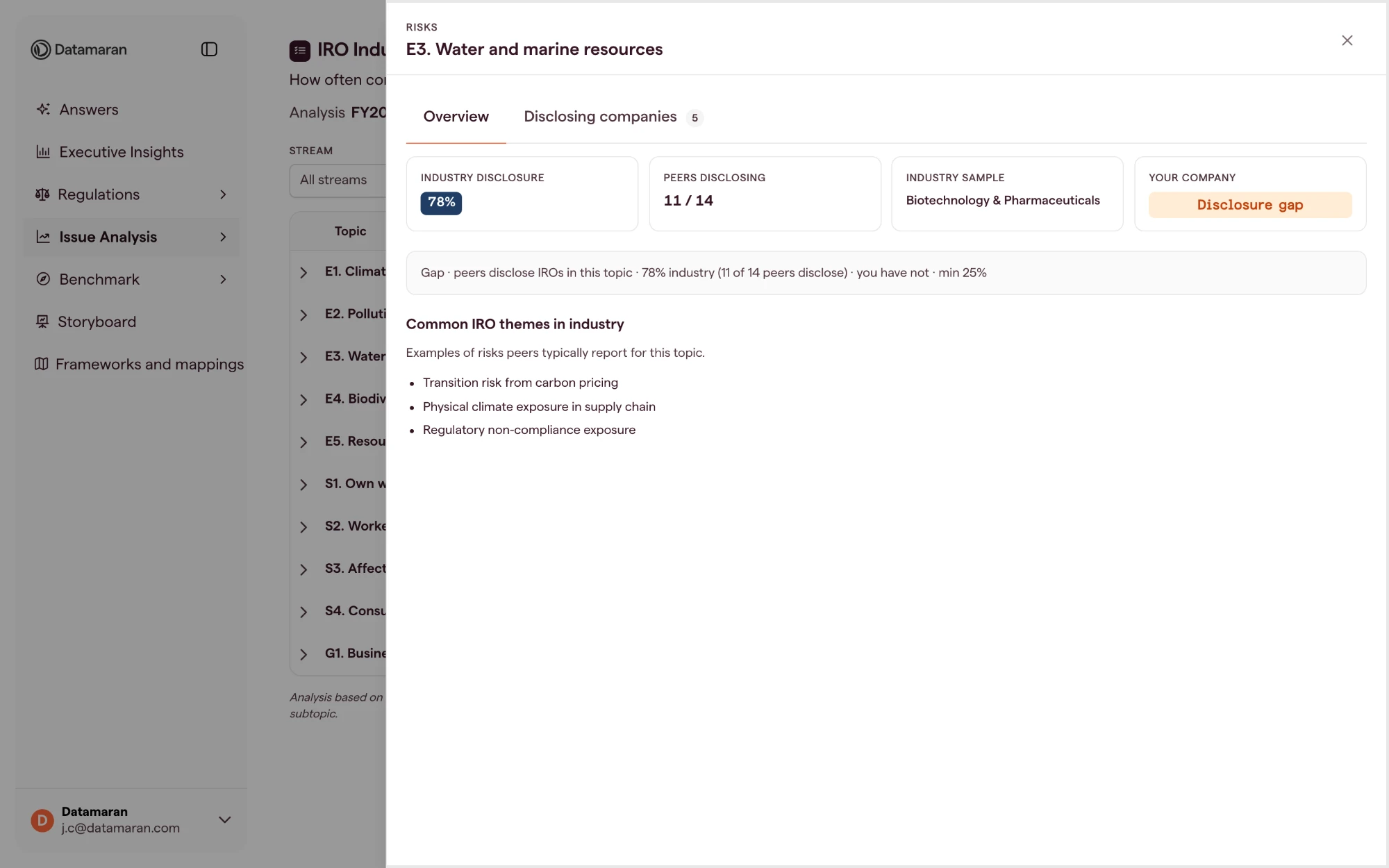
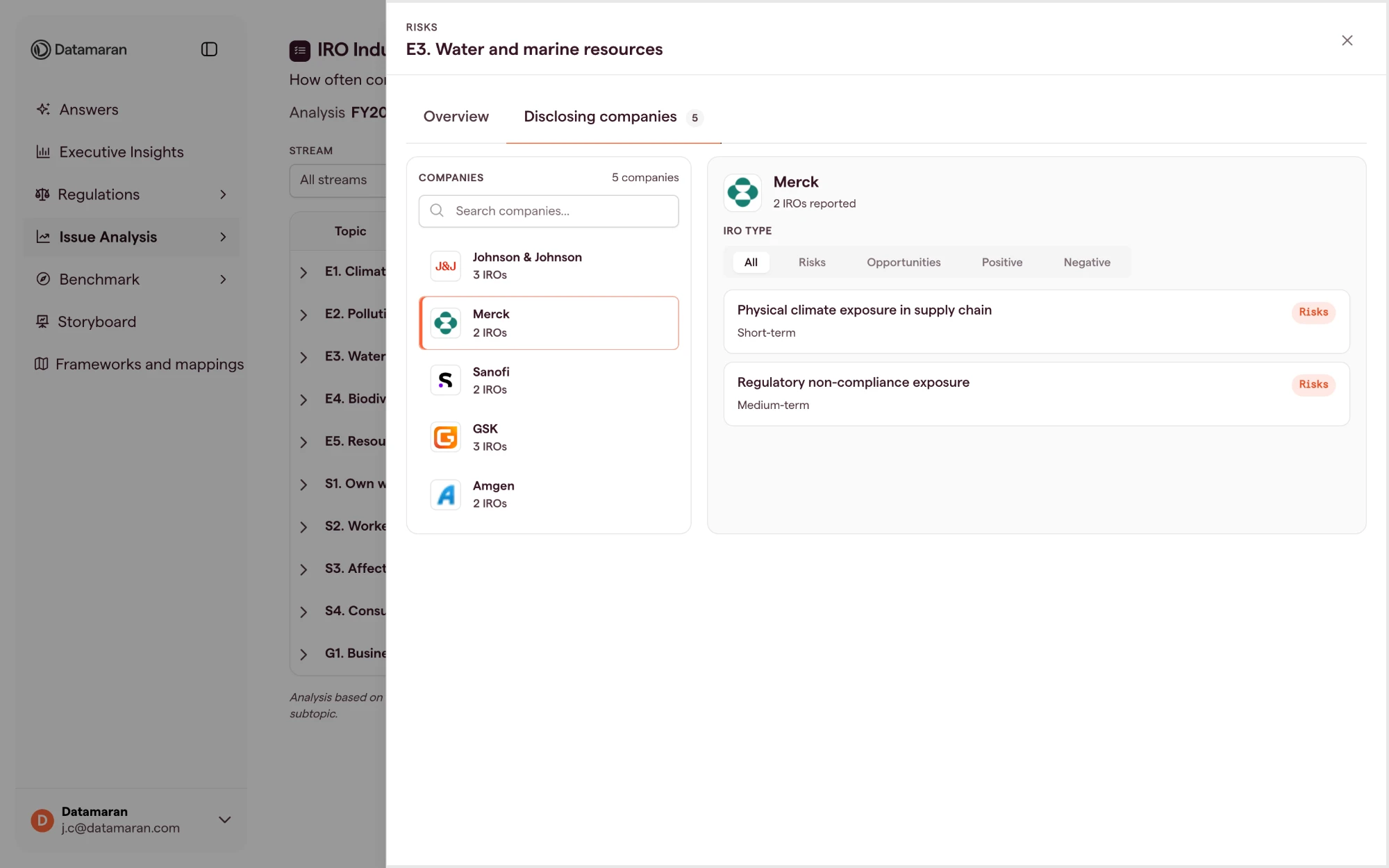
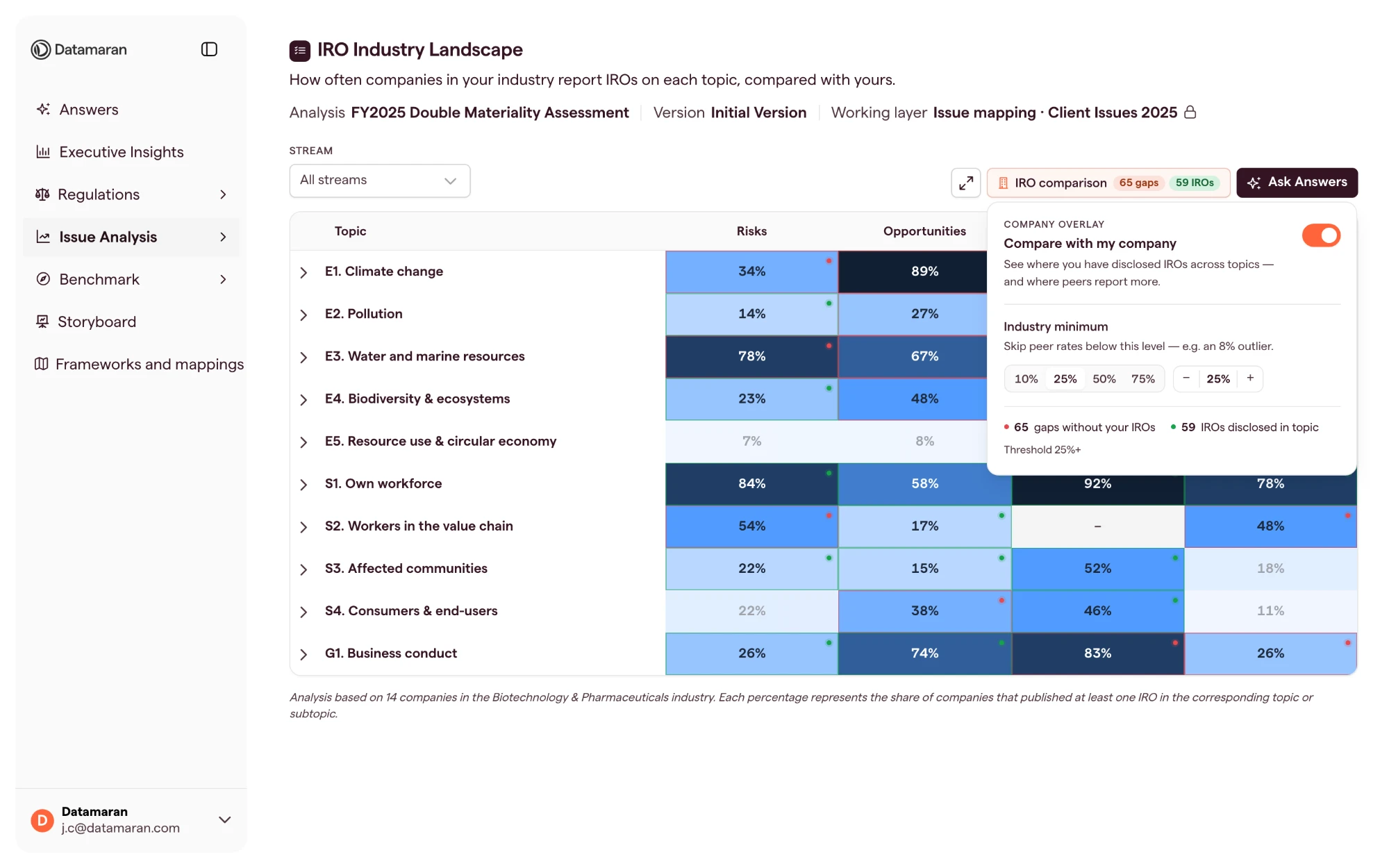
A heatmap of the whole industry: topics down the side, IRO types across the top, and the share of peers that report each one. One click shows the peer IROs, and an overlay marks where the user's own list has gaps.
2. AI Assistant
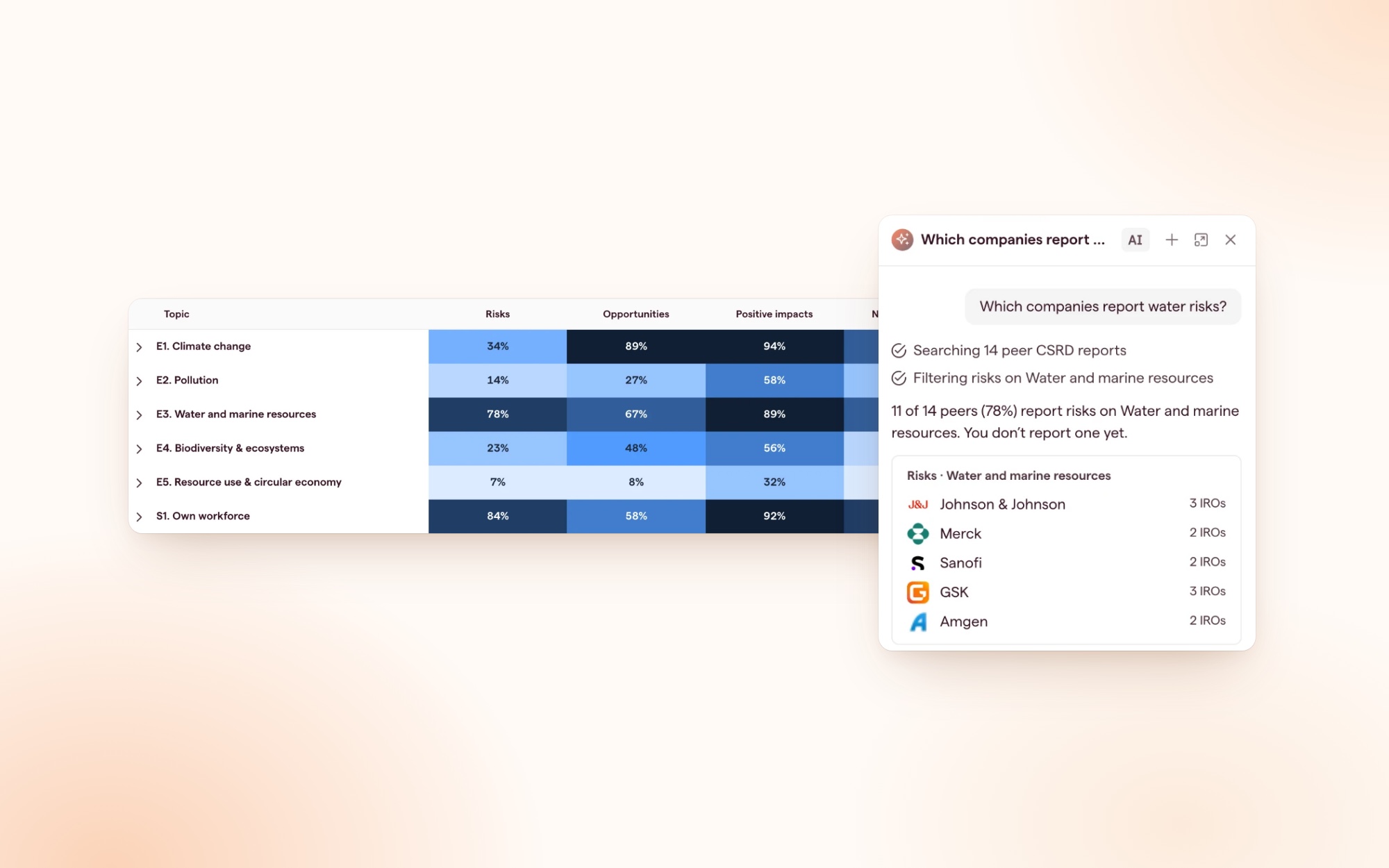
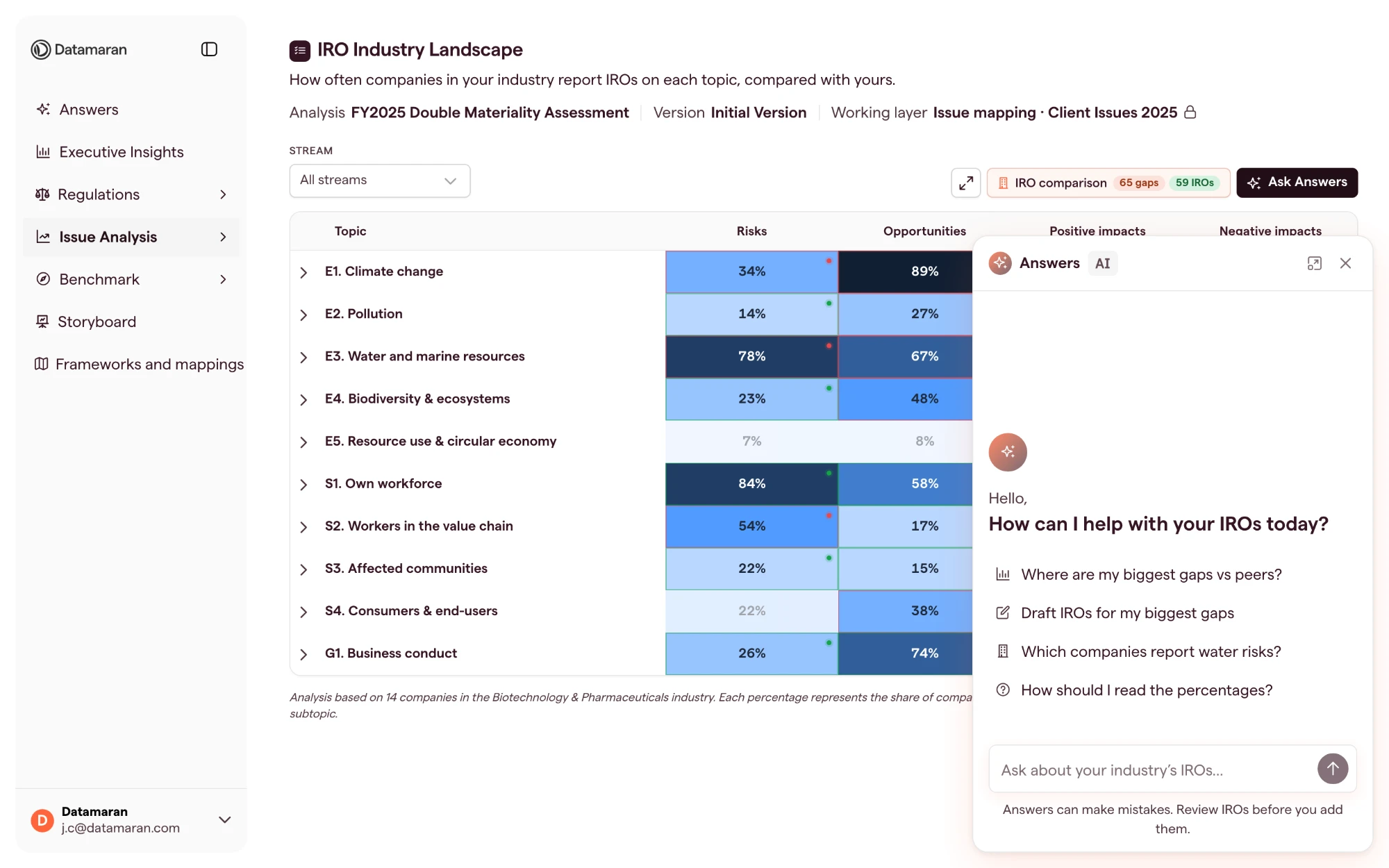
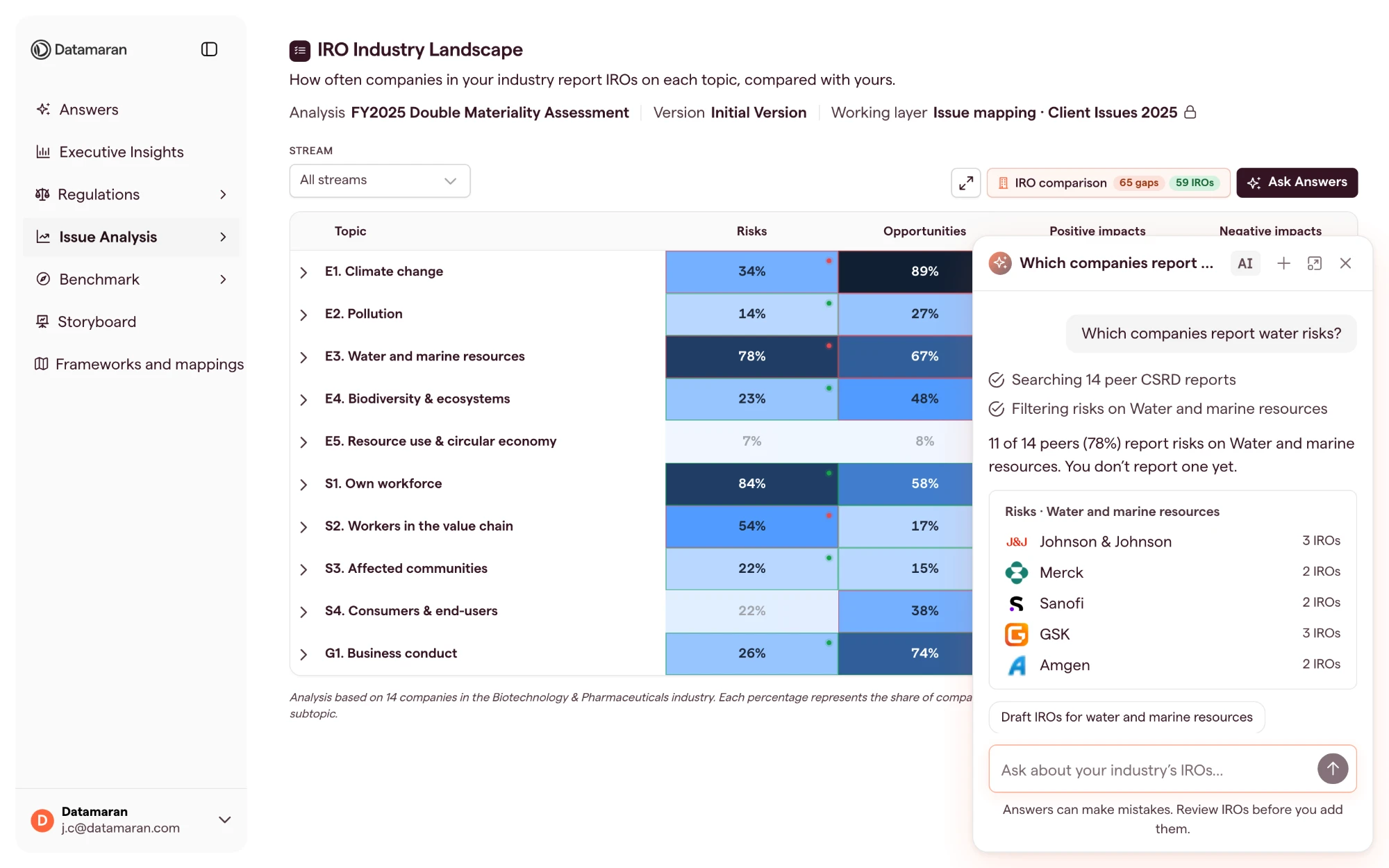
Users can simply ask about their industry. Instead of walls of text, the assistant answers with the right component: a chart, a list of peers, a gap card or a ready-to-add IRO.
3. Co-Creation Assistant
For every gap, the assistant drafts an IRO adapted to the user's company. They refine it by chatting or editing, and add it to their list in one click.
Designing for trust
Reports are audited, so every number has to hold up. Every answer links to its source, “no data” is never shown as 0%, and the AI never makes decisions for the user:
| Impact | Example | What the AI does |
|---|---|---|
| Low | Answer a question, show a chart | Acts on its own, with sources |
| Medium | Draft or edit an IRO | Suggests, the user confirms |
| High | Mark a topic as material | Never acts, the user decides |
Did we solve the problem?
Yes. We tested it with 8 sustainability managers and 300 real client questions. What used to take weeks of reading reports now takes minutes, without leaving the assessment.
Clients use it actively during their assessments: they add IROs to their analysis straight from the IRO Landscape, and those IROs end up in the final analysis they present to their board and auditors.
It also opened a new business line: Datamaran now sells the IRO Landscape as a separate product.
- 87%of drafted IROs accepted as is or with minor edits
- 100%of assistant numbers match the heatmap